The plan for the restoration of the Tsar of Czechoslovakia
The Secret of ChimneysThe Herzoslovakian royal restoration is a political project to replace the republic with a monarchy, bringing Prince Michael Obolovitch to the throne with British support and financial backing linked to oil concessions. Its apparent diplomatic and commercial design rests on a damaged royal past and a precarious succession: Count Stylptitch’s memoirs threaten to disrupt the negotiations, Michael’s murder leaves the succession unsettled, and the presumed-dead Prince Nicholas is revealed as Anthony Cade.
Historical Background and Political Stakes
The restoration plan responds to a revolution that ended the reign of King Nicholas IV and Queen Varaga and established a republic. In Anthony Cade’s account, the king’s marriage to a former Paris music-hall performer, whom he had elevated to Queen Varaga, provoked discontent in a society he described as strongly attached to royal legitimacy. An uprising overthrew the monarchy, and the king and queen were killed. The country remained a republic, although political violence continued. This history makes restoration more than a change of government: it asks a country shaped by revolution to accept another royal claimant.
Count Stylptitch, an adherent of monarchical principles, had gone to Paris after the king’s assassination. Although people wanted him to return and become president, he refused; he was also reported to have remained involved in Balkan political affairs. After his death in Paris, his memoirs became an immediate obstacle to the new restoration effort. The manuscript was to be delivered to a London publisher by October 13, with a thousand pounds promised to its bearer, Anthony. The disclosure of its contents could undermine the negotiations at precisely the moment that the restoration was being arranged.
The Proposed Settlement
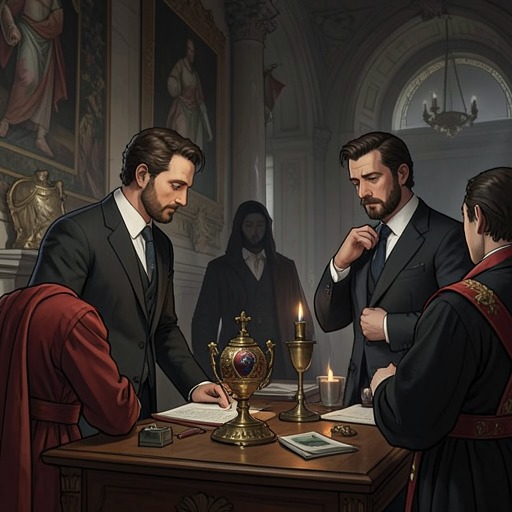
George Lomax explains the government’s stake in the plan: a misstep in the Herzoslovakian affair could jeopardize the effort to secure oil concessions for a British company. He expects Prince Michael to arrive at Chimneys at the end of the week, where the business can be conducted under the cover of a shooting party. The country’s dynastic future is thus addressed through a private gathering at an English estate, while public diplomacy and commercial negotiation remain closely joined.
The memoirs pose a specific political threat. Lomax argues that their publication could ruin the restoration project, not because readers would ignore them but because they would read them eagerly. He says that people in Herzoslovakia wish to restore the monarchy and are prepared to offer the crown to Prince Michael, who enjoys the support and encouragement of the British Government. The plan therefore depends not only on finding a claimant but also on protecting the political conditions under which his claim can be advanced.
The financial arrangement is still being negotiated when Michael comes to meet Herman Isaacstein. Battle later explains that no exact terms have yet been settled, but that Michael has pledged oil concessions to companies in which Isaacstein has an interest if he reaches the throne. The British Government is prepared to support Michael’s claim because of his pronounced British sympathies. Restoration is presented as a political bargain: royal recognition and external support are connected to a loan and access to oil.
Succession and the Crisis of the Claim
The plan’s vulnerability becomes explicit after Michael is murdered. Battle tells Lomax and Isaacstein that they have lost their intended king and must find another quickly. Isaacstein acknowledges that the matter is a very large deal, then asks who stands next in the line of succession. Lomax answers reluctantly that Prince Nicholas is probably the next heir. The conversation exposes the gap between the immediate political arrangement, centered on Michael, and the older dynastic rules that determine who may follow him.
Battle identifies Prince Nicholas as Michael’s first cousin and says that the authorities have reason to believe he is in the United States, where he had until recently been raising money on his expectations. That detail links the succession claim to the same financial world in which the restoration is being negotiated. Yet Nicholas’s position is not merely an alternative name on a list: his presumed absence has shaped what the other participants believe is possible.
Anthony Cade and the Restoration’s Reversal
Anthony had earlier said that, after receiving the promised two hundred and fifty pounds for delivering the manuscript, he intended to go to Herzoslovakia and “stand in with the republic,” perhaps ending up as president. His remark initially sets the restoration in ironic contrast with a possible republican career. He is not introduced as a visible royal claimant, and the apparent separation between his plans and the dynastic negotiations helps conceal the significance of his identity.
That separation collapses when Anthony speaks to Isaacstein after Michael’s death. Isaacstein asks whether the same loan can be offered to Michael’s cousin on the same terms and questions whether Nicholas can be produced, since he thought Nicholas had been killed in the Congo. Anthony confirms that the report of his death was deliberately spread, clarifies that he means he caused the report rather than committed a murder, and identifies himself as Nicholas Sergius Alexander Ferdinand Obolovitch. He says he had left the Congo as plain Anthony Cade because that identity suited the life he intended to lead. The succession crisis thus brings the supposedly unavailable heir directly into the restoration negotiations, while revealing that the man who had contemplated joining the republic is himself a prince.
Political Meaning and Limits
The restoration scheme is presented as a chain of contingent arrangements rather than a settled return to monarchy. It depends on public willingness to accept a royal claimant, British support, Isaacstein’s financial participation, proposed oil concessions, the handling of Stylptitch’s politically dangerous memoirs, and the survival of a credible line of succession. Michael’s death breaks the plan’s central arrangement; Nicholas’s reappearance offers a possible replacement but also changes the understanding of the negotiations and of Anthony’s role within them.
The contrast between revolution and restoration remains unresolved in the evidence. The republic arose after the destruction of the royal family, yet those seeking a new king treat dynastic succession as a practical answer to the loss of their chosen claimant. The proposed settlement reaches no final outcome in these scenes: it establishes the stakes and reveals Nicholas’s identity, but leaves the future form of Herzoslovakia and the terms of any new royal arrangement open.